White label SEO reports
A white label SEO report is a client report that carries your agency's branding and nobody else's — your logo, your colours, your sender name on the email, and no trace of the software that produced it. The promise sounds simple, and most reporting tools technically keep it. The problem is what's inside the wrapper.
The wrapper isn't the hard part
Any tool can put your logo on a PDF. The hard part is producing something your client — a plumber, a dentist, a shop owner — will actually read and value. Most white-label reports fail this test in the same three ways:
- They're organised around data sources, not questions. A Search Console section, an Analytics section, a rankings section. Your client doesn't think in data sources. They think: did last month go well? Is this SEO thing working? Which pages are earning me money?
- They're full of jargon. Impressions, CTR, average position, bounce rate. Every one of those terms makes the report feel like it was written for you, not for them — and it quietly signals that the report is a data export, not a service.
- They show numbers without judgement. A chart of clicks going up is not analysis. Analysis is: two of your pages are competing for the same search and splitting the credit. This page gets the most visitors but almost no enquiries. This search shows you 2,000 times a month and you're two positions off page one.
What a good white-label report contains
After sending these reports for years, here's the structure that gets read:
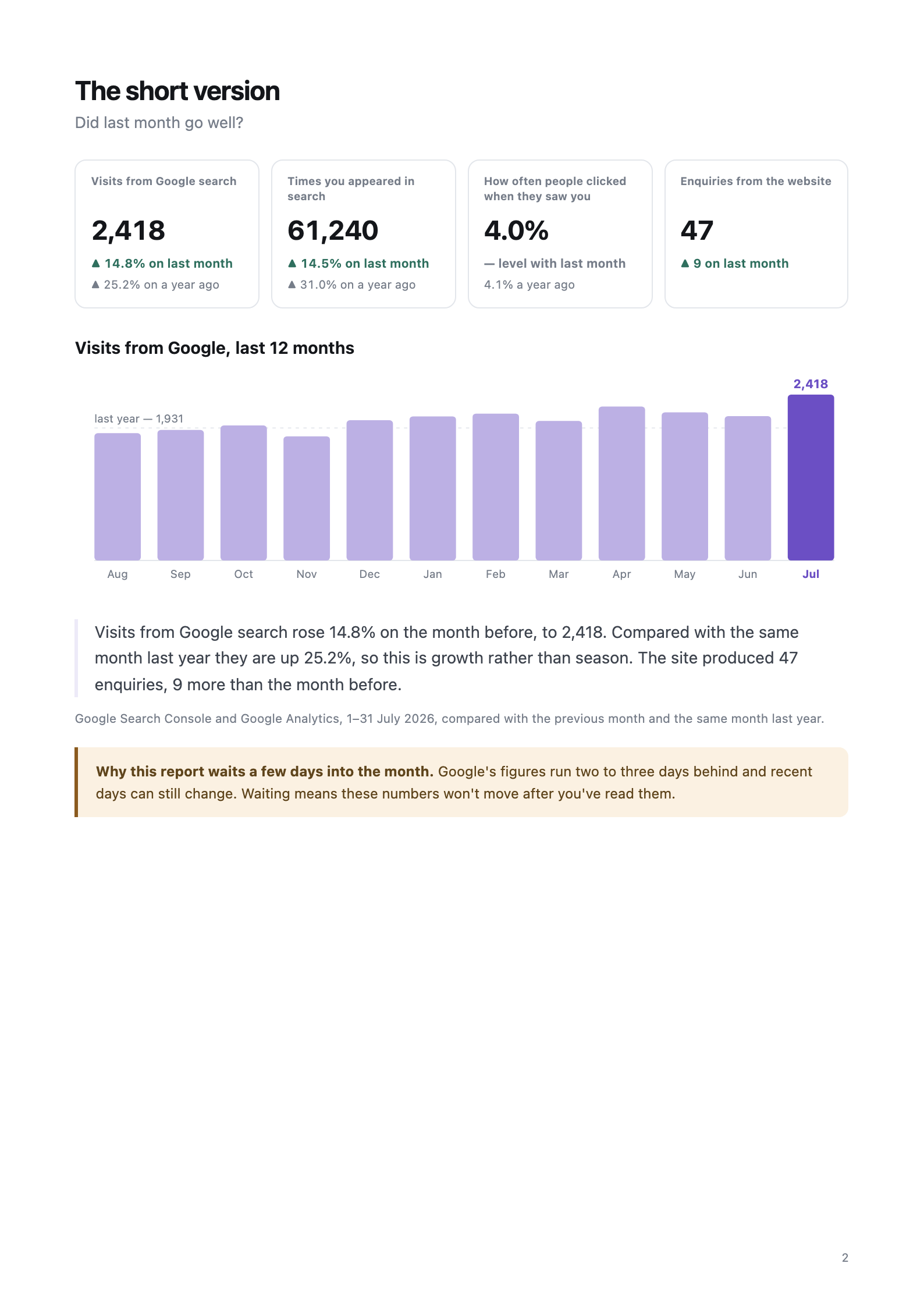
- The short version. Four numbers with month-on-month and year-on-year comparison — seasonal businesses are misled by month-on-month alone — and a few sentences of plain English.
- Who found you. The split between people who searched the business name and people who searched for a service. If service searches are growing faster, the SEO is working. If name searches are, the brand is. Almost no report shows this, and it's the number that proves your work.
- What actually brought business. Visits and enquiries, page by page. The page with the most traffic and the page producing the most enquiries are rarely the same page — and that divergence is usually the most valuable thing in the whole report.
- Nearly working. Searches sitting just off page one with real demand. Rankings already held where the listing isn't earning its click. Quantified in visits, not percentages.
- What's slipping. The six-month slides that nobody notices until the client does.
- Things that look alarming and aren't. Why average position "dropping" while visibility grows is good news. This one section eliminates most of the worried Monday-morning emails.
- What we'd do next. Three prioritised recommendations tied to the numbers above — in your voice, because your name is on the cover.
That's exactly the structure of our sample report — it's not gated, go and read it. This is what page two looks like:
The pricing problem with white-label tools
Nearly every white-label reporting tool charges per client. That model has a property agencies only notice once they're locked in: the bill grows every time you win work. At an illustrative mid-teens rate per client, 25 clients is around £390 a month for reporting — and client 26 puts it up again.
YourReporting charges by plan instead: £39 a month for up to 5 clients, £79 for up to 20, £129 unlimited. Inside a plan, adding a client costs nothing. At 25 clients you'd be on £129 — and still £129 at 40. The pricing page has the full comparison table, and the AgencyAnalytics, Swydo and DashThis comparisons go tool by tool. If your question is workflow rather than price, see client reporting for agencies.
Questions agencies ask about white-labelling
Is the email white-labelled too? With us, yes — the sender name and reply-to are yours, and replies come to you. A surprising number of tools brand the report but send it from their own domain.
Do my clients need logins? No. The report arrives as a PDF in their inbox once a month. Nobody has to remember a dashboard exists.
What if the data can't be fetched one month? The report degrades section by section rather than failing — if PageSpeed is unavailable, that page is omitted; the report still sends. A missing section is a footnote; a missing report is a fire.
When should reports go out? Not on the 1st. Search Console runs two to three days behind and its recent days are still provisional; Analytics takes 24–48 hours to settle. We send on the 4th by default — the earliest the numbers hold still — and print a one-line explanation on the report so the timing reads as rigour, not delay.
14 days, no card, all features. £39, £79 or £129 a month after that — never per client.